Reflect Better, Grow Faster: Printable Weekly Review Guide

Reflect Better, Grow Faster: A Practical Printable Guide to Learning From Successes and Failures
Reflection turns experience into usable lessons. Without a simple process, wins can feel random and setbacks can repeat. This printable digital guide is designed to help capture what happened, why it mattered, and what to do next—so progress becomes easier to measure and quicker to repeat.
Why reflection accelerates self-growth
Growth gets faster when you stop relying on memory and mood to decide what “worked.” A short, consistent reflection habit creates a feedback loop between actions and outcomes, so you can spot patterns you’d otherwise miss.
- Creates a clear feedback loop between actions and outcomes
- Helps separate controllable factors (effort, planning, communication) from uncontrollable ones (timing, other people’s choices)
- Builds self-awareness without spiraling into self-criticism
- Improves decision-making by documenting patterns over time
- Makes progress visible, which strengthens motivation and follow-through
There’s also a practical emotional benefit: writing about experiences can reduce stress and help you process what happened, especially when you put feelings into words and then move toward meaning. The American Psychological Association discusses how writing about emotions may ease stress and trauma (APA source).
A simple framework: capture, interpret, adjust
A lightweight structure keeps reflection helpful instead of heavy. The goal isn’t to produce perfect insights—it’s to consistently create one clear improvement you can test.
- Capture: write down what happened while details are fresh (facts first, feelings second)
- Interpret: identify the “why” behind the result—skills, systems, support, constraints, and choices
- Adjust: choose one small change for the next attempt to avoid overhauling everything at once
- Repeat: treat each cycle as an experiment rather than a verdict on ability
- Keep it lightweight: consistency beats depth when building a reflection habit
Quick reflection loop you can print and reuse
| Step | Prompt | Output |
|---|---|---|
| Capture | What happened? What did I do? | A short, factual recap |
| Name outcomes | What went well? What didn’t? | Wins and gaps listed clearly |
| Find causes | What factors influenced this? | Top 1–3 drivers identified |
| Choose a tweak | What will I do differently next time? | One specific next action |
| Schedule | When will I review again? | A date or trigger to revisit |
For staying consistent “in the thick of it,” Harvard Business Review highlights the value of making reflection a habit rather than an occasional event (HBR source).
What to reflect on after a success (so it’s repeatable)
Success feels great, but it can be surprisingly hard to reproduce if you don’t document what actually drove it. A good success review is less “celebrate” and more “extract the recipe.”
- Identify the true drivers of the win: preparation, timing, collaboration, environment, or persistence
- Record the conditions that supported success (sleep, routines, tools, accountability, calendar structure)
- Note what was harder than it looked—hidden effort is often the most transferable lesson
- Distill a “repeat recipe”: 3–5 bullet steps that can be followed next time
- Choose one way to raise the baseline (a small system upgrade instead of relying on motivation)
Example “repeat recipe” (keep it short): “Block 45 minutes on the calendar, prep materials the night before, remove one distraction, do the hardest step first, send a quick update when done.”
How to reflect on a failure without getting stuck
A productive failure review avoids the trap of turning a result into a label. The goal is to find the leverage point—the smallest controllable change that improves the next attempt.
- Separate the event from identity: one result is data, not a permanent label
- Look for breakdown points: where did the plan drift—start, middle, or finish?
- Check assumptions: what was believed to be true that wasn’t (time estimates, skill level, priorities, dependencies)?
- Focus on controllables: effort, planning, communication, practice, and boundaries
- Convert the lesson into a testable change: one adjustment to try within the next week
If you notice the same issue repeating, treat it as a systems problem instead of a willpower problem. Recurring lateness may be a calendar setup issue. Recurring stress may be a boundary issue. Recurring inconsistency may be a “too many goals at once” issue.
Using the printable guide as a weekly review ritual
What’s included in “Reflect Better, Grow Faster”
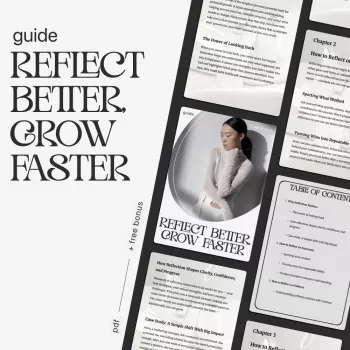
Reflect Better, Grow Faster | Self-Growth Digital Guide | Printable eBook on Ways to Reflect on Successes and Failures is built for quick clarity—so you can move from emotions to insight to action without needing long journaling marathons.
At-a-glance product details
| Detail | Value |
|---|---|
| Format | Digital guide (printable eBook) |
| Designed for | Reflecting on successes and failures |
| Best use | Weekly reviews, post-project wrap-ups, goal check-ins |
| Price | $22.99 USD |
| Availability | In stock |
Who this guide fits best
Keeping reflection sustainable: small changes that stick
If you’re also simplifying your environment to support follow-through, pair your weekly review with a quick reset routine. The Luxe Hacks for Small Closets Checklist | Digital Download Closet Organization Guide can complement reflection by reducing daily friction—less clutter often means fewer micro-decisions and more mental bandwidth for the habits you’re trying to build.
FAQ
How long should a reflection session take?
Most sessions work best at 10–25 minutes. Use a quick 10-minute version for busy weeks (one highlight, one challenge, one next step), and save deeper reviews for major projects or end-of-month check-ins.
Can this be used digitally or does it have to be printed?
It’s a digital guide you can either print or fill in digitally. Choose the format that makes weekly use easiest—printed pages for visibility, or a digital file if you prefer searchable notes and portability.
What’s the difference between reflecting and overthinking?
Reflection is structured learning that ends with a decision or next action; overthinking repeats the same questions without closing the loop. A simple stop rule is: write one takeaway and choose one next step, then schedule when you’ll revisit.










Leave a comment