Hand-Figured Refractor, XLT Coatings & Manual EQ Mount
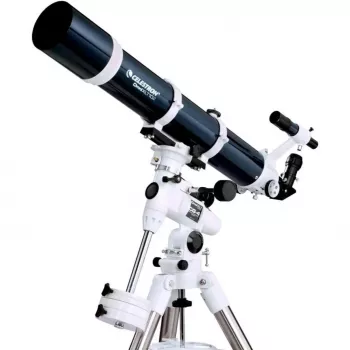
Hand-Figured Refractor Telescope with XLT Coatings and Manual EQ Mount: What Those Features Really Do
A hand-figured refractor paired with XLT-style multi-layer coatings and a manual equatorial (EQ) mount is built for sharp, high-contrast views and a satisfying, hands-on observing rhythm. The optical choices emphasize clean star images and darker backgrounds, while the EQ mount rewards a little setup time with smoother, more intuitive tracking across the sky.
If you’re considering a scope like the Hand-Figured Refractor Telescope with XLT Coatings and Manual EQ Mount, the sections below explain what to expect at the eyepiece and how to get the mount feeling steady, balanced, and easy to use.
What makes this refractor different
Refractors have a reputation for “snap-to” focus and pinpoint stars, and a hand-figured lens can push that experience even further. Instead of relying only on mass-production tolerances, hand figuring involves shaping and refining the optical surfaces to tighten the final image.
- Hand-figured optics: Aims for tighter star images and improved contrast—often most noticeable on the Moon, planets, and double stars where fine detail and clean edges matter.
- XLT-style coatings: Multi-layer anti-reflection coatings are designed to increase light transmission and suppress internal reflections, helping bright targets stay crisp against a darker background.
- Sealed-tube refractor practicality: A refractor’s closed optical tube typically needs less frequent collimation than many reflector designs, which can make it easier to grab and go with consistent performance.
- Who it suits best: Observers who value clean diffraction patterns, sharp detail, and low-maintenance optics—often choosing optical refinement over maximum aperture per dollar.
XLT coatings in real-world viewing
Coatings won’t turn a bright suburban sky into a dark-sky site, but they can meaningfully improve how the view “looks” through the eyepiece—especially on high-contrast objects and bright targets where stray reflections are most obvious.
- Higher transmission: Can make subtle features easier to notice, such as delicate lunar shading, Saturn’s ring contrast, and brighter nebula structure when the sky is already reasonably dark.
- Reduced reflections: Helps prevent bright objects (particularly the Moon) from washing out nearby detail, improving perceived sharpness and preserving darker tones.
- Sky conditions still rule: Coatings can’t overcome heavy light pollution; thoughtful timing, darker locations, and the right filters still make a bigger difference than any single optical upgrade.
- Cleaning discipline: Modern coatings are durable, but aggressive cleaning can cause micro-scratches that scatter light. Clean only when needed, and use proper tools.
For a deeper primer on getting the most from your telescope’s optics, the Celestron Knowledgebase has approachable fundamentals, and Sky & Telescope observing resources offer practical tips for planning sessions and improving technique.
Manual EQ mount basics: stable setup and smooth tracking
An EQ mount is different from a simple up-down/left-right mount because one axis can be aligned to match Earth’s rotation. With a decent alignment, you can keep an object centered mainly by turning a single slow-motion control—an observing style that feels surprisingly natural after a few sessions.
| Step | What to do | Why it helps |
|---|---|---|
| 1. Level and steady | Set tripod on firm ground; keep legs short | Reduces shaking and improves pointing |
| 2. Attach and tighten | Secure mount head and accessories | Prevents flex and shifting |
| 3. Balance DEC | Loosen DEC; slide tube to balance | Smoother motion, less drift |
| 4. Balance RA | Set counterweight position to balance | Protects gears and improves tracking feel |
| 5. Rough polar aim | Aim polar axis toward the celestial pole | Tracking mainly uses one control |
What can be seen with a high-quality refractor
For seasonal targets and what’s up tonight, NASA’s night sky resources are a reliable companion for planning.
Choosing eyepieces and accessories that match the optics
Care, storage, and long-term performance
Product options in stock
If you want precision refractor optics and hands-on equatorial tracking in one package, the Hand-Figured Refractor Telescope with XLT Coatings and Manual EQ Mount is currently available. Before purchasing, confirm what’s included (eyepieces, diagonal, finder, and counterweights) so your first nights match the observing style you have in mind.
- Luxe Hacks for Small Closets Checklist (Digital Download) for organizing a small gear corner and protecting accessories from clutter.
- 20Kpa Cordless Stick Vacuum Cleaner for Hard Floor, Carpet & Pet Hair for keeping dust under control around storage and setup areas.
FAQ
Is a manual equatorial mount hard to use at first?
There’s a learning curve, but it’s mostly about balancing the telescope and doing a rough polar alignment. After a few sessions, single-axis tracking with the slow-motion control becomes intuitive and noticeably more comfortable than constantly nudging in two directions.
Do XLT-style coatings make a noticeable difference?
They can, especially on bright or contrasty targets where internal reflections would otherwise reduce perceived sharpness. The improvement is most noticeable when the optics are clean, the telescope is well cooled, and the sky conditions are cooperative.
Can this telescope be used for astrophotography?
It can handle casual imaging and short exposures, particularly of the Moon and brighter planets. For long-exposure deep-sky work, most setups benefit from a tracking motor drive and more precise polar alignment than a typical manual visual session requires.










Leave a comment